
Understanding Cycles – how they work
Natural cycles that occur in all aspects of life are governed by the time factors found in our Solar system and are recurring periods of time of specific values. It is important to note they can exponentially increase in duration as time moves forward.
Individual markets such as the S&P 500 will contain their own cycles that are the time periods between particular data points and can vary in duration. They are related to the natural cycles in that they are the harmonic parts – in various forms, of these cycles and will ultimately align with a complete cycle at a reversal. The greater the cycle usually results in a more important reversal.
SP-500 Planetary cycle alignment with SPX cycles
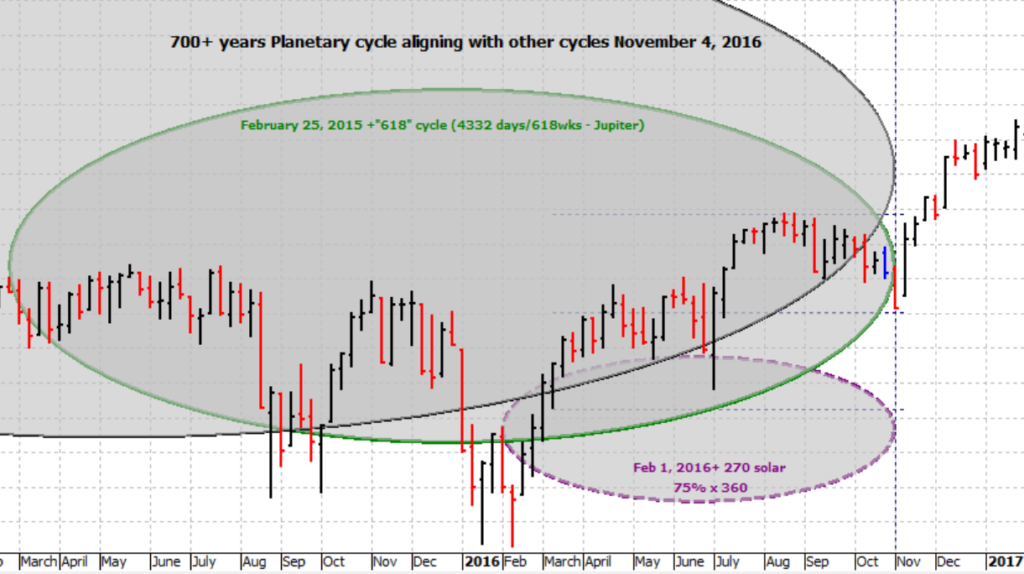
Cycleforecasts uses research into both of these types of cycles to determine when the S&P 500 may be subject to the factors required for a reversal to occur. The analysis is based on historical data, market data points and cycle types.
The methodology is based on the research of WD Gann and other renowned market timing analysts, while also applying our independent analysis to current S&P 500 market behaviour. WD Gann’s work explored cycles and the relationship between time, price, and market behaviour.
Cycles influence both short-term and longer-term market movement. Cycles originating from significant historical data points or lesser importance data points will have differing effects. The various cycles will produce different results.
The effect of a cycle also will depend on:
- Current market structure
- Broader trend direction
- Volatility conditions
- Time and price alignment
- Whether the cycle supports or opposes the existing trend
Cycle forecasting requires knowledge of the specific cycles, an understanding of how time needs to be calculated and what activates a cycle for it to be effective. This is critical as there are many cycles operating concurrently, however activation triggers are critical for a given cycle to work and explains why some cycles will work and at other times they will not be effective.
From originating data points, specific calculations can project future timing dates where the market may encounter either support or resistance that will lead to an S&P 500 reversal.
Intermediate magnitude cycles enable minor and intermediate reversals to be more easily determined due to more recent historical data being available and reliable.
The dates of major reversals require much greater historical data which is not always complete or accurate. However when larger cycles appear to align with intermediate cycles it is noted in our reversal forecasts.
Quotes by WD Gann
“The limit of future predictions based on exact mathematical law is only restricted by lack of knowledge of correct data on past history to work from”
”Every movement in the market is the result of a natural law, and a cause which exists long before the effect takes place and can be determined years in advance. Everything moves in cycles as a result of the natural law of action and reaction. By a study of the past I have discovered what cycles repeat in the future”
“It is just as easy to figure 100 years or 1000 years in the future as one or two years ahead, if you have the correct starting point and know the cycle which is going to be repeated”